2025 Christian Journal KDP Interior
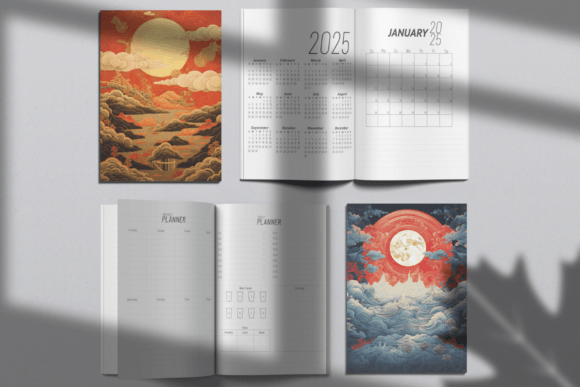
If you're preparing to publish a faith-centered journal on Amazon KDP—or even just designing one for personal or small-group use—the 2025 Christian Journal KDP Interior is more than a template. It’s a thoughtfully structured, print-ready foundation built for spiritual intentionality and practical usability. At its core, it delivers 30 pages of versatile layouts—including a full-year 2025 calendar, monthly and weekly planners, daily reflection prompts, and multilingual Christian meditation pages (English, Korean, and Japanese). Plus, it includes bonus line-and-dot blank pages and comes in high-resolution PDF, EPS, and PNG formats—each at 300 dpi—so you can scale confidently for print without pixelation.
But here’s what many creators overlook: a beautifully designed interior doesn’t automatically translate into a successful, satisfying, or well-received journal. Too often, users assume “ready-to-upload” means “ready-for-everyone”—and that’s where small oversights compound into real-world issues: misaligned margins, unreadable fonts at smaller sizes, inconsistent spacing across language versions, or even unintentional watermarking (though this particular file explicitly states downloaded versions are watermark-free).
Common Missteps—and Why They Matter
Assuming all 8.5 x 11-inch interiors print the same way. Not true. KDP has precise margin requirements—especially for bleed and safe zones—and while this 2025 Christian Journal KDP Interior is sized correctly, resizing manually in non-professional software (like basic photo editors) can distort line weights, crop meditation text, or compress spacing between Korean or Japanese characters, affecting readability. One creator resized the PDF in a free online tool and ended up with clipped headers on the monthly planner—requiring a full redesign before re-uploading.
Skipping a test print before final upload. Screen previews don’t reveal how light gray meditation lines render on matte paper, or how tightly spaced Korean script appears when printed at 100% scale. A quick black-and-white laser print on standard copy paper takes five minutes—and saves weeks of customer complaints about “faint text” or “crowded layouts.”
Misunderstanding file format strengths. The inclusion of EPS and PNG files is a real advantage—but only if used intentionally. EPS is ideal for vector-based edits (e.g., adjusting logo placement or repositioning page numbers), while PNG works best for digital previews or social media mockups. Using PNG for final KDP upload? That risks compression artifacts and blurry edges. Always upload the PDF version for publishing—it preserves fonts, layers, and color fidelity exactly as intended.
What to Verify Before You Upload or Print
Before treating the 2025 Christian Journal KDP Interior as “done,” run through these checks:
- Margin integrity: Open the PDF in Adobe Acrobat (or another reliable PDF viewer) and enable rulers (View > Show/Hide > Rulers). Confirm top, bottom, inside, and outside margins meet KDP’s current guidelines—currently 0.25 inches minimum for standard trim size, with no critical content within the 0.125-inch bleed zone.
- Font embedding: In Acrobat, go to File > Properties > Fonts. Ensure all fonts are listed as “Embedded Subset.” If any show as “Not Embedded,” text may render incorrectly on KDP’s servers—or worse, default to an unintended font.
- Bilingual balance: Flip through the English, Korean, and Japanese meditation pages side by side. Do line heights accommodate Hangul’s vertical density and Japanese kanji stroke complexity? This design does—but verify spacing remains generous (at least 1.4 line height) when zoomed to 150% on screen.
- Page count logic: Though labeled “30-paper design,” remember that KDP counts *physical sheets*, not sides. So 30 pages = 15 sheets front-and-back. If you plan to add covers or extra resources, adjust your total count accordingly to avoid unexpected pricing or thickness issues.
Better Choices for Real-World Use
Instead of rushing straight from download to upload, try this sequence:
- Start with the PDF—open it in Acrobat and export a single-page “test version” (e.g., just the January monthly planner). Print it at actual size on plain paper. Hold it next to a ruler. Does the 8.5 x 11-inch boundary match?
- Use the EPS only for structural tweaks—like moving the copyright line lower on the title page or adjusting the header font weight. Don’t edit body text in EPS unless you have full font licenses; otherwise, stick to the PDF’s editable text fields (if enabled) or use KDP’s built-in text tools sparingly.
- Leverage the blank line-and-dot pages intentionally. These aren’t filler—they’re flexible space for sermon notes, prayer lists, Scripture journaling, or even small-group discussion prompts. Consider adding subtle headers (“Prayer Focus,” “Verse Reflection,” “Gratitude Log”) in your own design layer before uploading.
- Localize mindfully. Since Korean and Japanese pages are included, double-check that date formats, weekday abbreviations, and cultural references align with regional expectations. For example, the Korean version uses the lunar calendar for certain observances—this interior respects those conventions, but always cross-reference with native speakers if distributing beyond personal use.
Finally, remember: the strength of the 2025 Christian Journal KDP Interior lies not just in its completeness, but in its flexibility. You’re not locked into 30 pages—you can duplicate weekly spreads, remove unused sections, or interleave blank pages between meditation prompts. One educator added her own Bible reading tracker between the daily and weekly planners, using the included dot-grid as a base. Another entrepreneur bundled the journal with a short audio devotional—linking QR codes on the cover page to private podcast episodes.
What matters most isn’t how many features it includes, but how thoughtfully you steward them. A clean layout supports contemplation. Consistent spacing honors attention spans. Multilingual access reflects real ministry reach. And high-resolution files honor the effort readers invest in holding something tangible—something that helps them pause, reflect, and grow in faith throughout 2025.