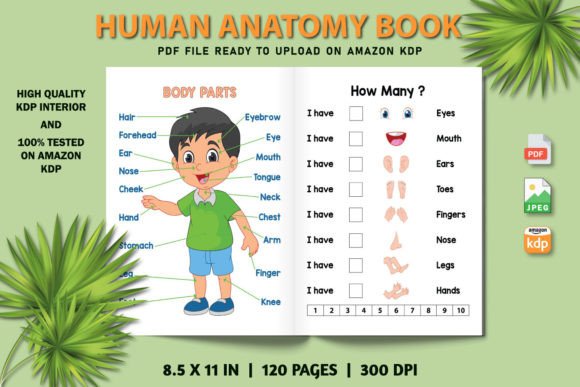
Human Body Parts Name KDP Interior
If you're designing a printable workbook, classroom handout, anatomy study guide, or therapeutic activity pack—and need a professionally formatted, print-ready interior for Kindle Direct Publishing (KDP)—the Human Body Parts Name KDP Interior is built for real-world usability. It’s not just a collection of labeled diagrams. It’s a thoughtfully structured 120-page resource designed to support recognition, retention, and writing fluency around core human body vocabulary—tailored for adults who teach, create, or learn with intention.
Where This Interior Fits in Real Life
Imagine you’re a homeschool parent preparing a science unit on the human body. You’ve found great videos and models—but your child learns best by writing, tracing, and naming. The Human Body Parts Name KDP Interior gives you ready-to-print pages: blank outlines of the skeletal system with dotted-line labels to trace; matching exercises pairing terms like “trachea” and “esophagus” with simple illustrations; and fill-in-the-blank paragraphs that reinforce function alongside form. No design time. No formatting guesswork. Just open the PDF, hit print, and go.
Or picture yourself as a speech-language pathologist working with adult clients recovering from stroke or aphasia. Naming body parts is often an early functional goal—not because it’s medically urgent, but because it rebuilds neural pathways tied to self-awareness, safety, and daily communication (“I feel pain in my *kneecap*,” “My *temporal lobe* feels foggy”). This interior includes repetition-based writing grids, labeling challenges with increasing complexity (e.g., distinguishing “ulna” from “radius”), and clean, uncluttered layouts that reduce visual fatigue—critical when cognitive load is high.
Who Benefits—and How
Educators & Curriculum Designers: You can drop this interior directly into a larger anatomy-themed workbook—say, one that also covers nutrition, movement, or health literacy. Because it’s sized to 8.5″ x 11″ with no bleed, it aligns perfectly with standard US letter paper and most binding services. Teachers using it report spending 60–75% less time prepping handouts, especially during back-to-school season or IEP-driven planning cycles.
Occupational Therapists & Rehab Specialists: The writing practice isn’t decorative—it’s purpose-built. Letters are sized for adult handwriting (not preschool tracing), with consistent spacing and baseline cues. Pages include both cursive and manuscript options, and many prompts encourage descriptive phrasing (“Write three ways your *lungs* help you every day”)—supporting expressive language goals without requiring custom worksheet creation.
Self-Paced Learners & Lifelong Students: Whether you’re studying for a nursing exam, brushing up before volunteering at a clinic, or simply curious about how your body works, this interior meets you where you are. One user shared how she used the “Organs of the Human Body” section to build flashcards—cutting out each page, folding it in half, and testing herself during coffee breaks. Another printed just the “Body Systems Overview” pages and kept them in a binder beside her treadmill, reviewing while walking.
What Makes It Practical—Not Just Pretty
The Human Body Parts Name KDP Interior avoids common pitfalls of anatomy resources aimed at adults. It doesn’t overload with Latin roots unless they’re clinically relevant (e.g., “myocardium” appears alongside “heart muscle”). It doesn’t assume prior knowledge—but also doesn’t talk down. Terms like “cerebellum,” “patella,” and “phalanges” appear in context, paired with clear, consistent visuals—not clip art, but clean, high-contrast line drawings optimized for grayscale printing.
Each section flows intentionally: start with whole-body orientation, then zoom into systems (skeletal → muscular → nervous → circulatory), then drill into individual organs and structures. Writing prompts evolve too—from copying single words (“tibia”) to sentence-level application (“The tibia supports weight when standing and absorbs shock when walking”). That progression mirrors how adults actually internalize terminology: through repetition, variation, and personal relevance.
Things to Keep in Mind Before You Use It
This interior is designed for flexibility—not automation. While it’s print-ready, it’s not plug-and-play for digital learning platforms. If you plan to adapt it for online use (e.g., uploading to Google Classroom), you’ll want to convert select pages to interactive PDFs or image-based drag-and-drop activities separately.
It assumes basic English literacy—but not medical training. So if you’re creating material for ESL learners or neurodivergent adults, consider adding glossary cards or audio support. One special educator added QR codes linking to pronunciation guides—turning static pages into multimodal tools.
Also worth noting: the resource focuses on *named parts*, not pathology or disease states. You won’t find pages on “signs of appendicitis” or “stages of COPD.” That’s intentional. Its strength lies in foundational accuracy and clarity—not clinical expansion. Pair it with trusted medical sources if deeper health context is needed.
Why Print Quality Matters More Than You Think
The high-resolution JPG and print-ready PDF files aren’t just about sharp lines—they impact usability. Low-res images blur when enlarged or photocopied, making fine details (like distinguishing the *scapula* from the *clavicle*) hard to see. This interior uses vector-friendly line work and generous label spacing, so even photocopies hold up in busy clinics or classrooms with aging printers.
And because there’s no bleed, margins stay predictable across devices and printers. No more cropped labels or vanishing footnotes—a small detail that saves hours when assembling multi-section books or updating editions.
A Resource That Grows With Your Needs
One of the quiet strengths of the Human Body Parts Name KDP Interior is its modularity. You don’t have to use all 120 pages at once. A yoga instructor might pull just the muscular system pages to accompany a workshop on alignment. A geriatric care trainer could isolate the “Sensory Organs” section for staff onboarding. A writer developing a medical thriller might use the labeled diagrams as reference while drafting scenes involving injury or recovery.
It’s also creator-friendly: the consistent typography, spacing, and grid structure make it easy to insert your own branding, notes, or supplemental content. Many users add short reflection prompts (“When did you last notice your *diaphragm* working?”) or cross-reference with free anatomy apps like Complete Anatomy or BioDigital Human.
In short—the Human Body Parts Name KDP Interior meets adults where they are: curious, time-pressed, and committed to meaningful learning. It doesn’t replace deep study—but it removes friction between intention and action. Whether you’re building a product, supporting a client, or relearning your own body, it’s a grounded, adaptable, and quietly powerful place to begin.