Innovative Puzzles for Kids KDP Interior
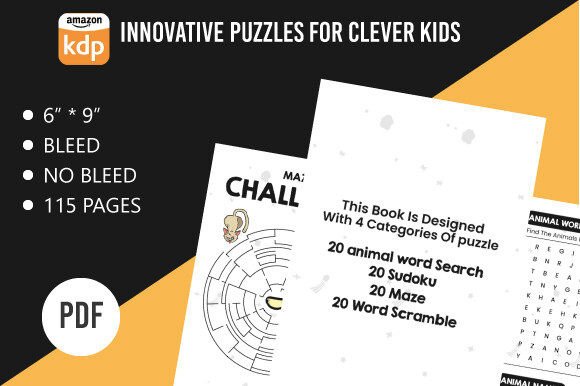
If you're designing a children’s activity book for Amazon KDP—and want to skip formatting headaches while keeping creative control—you’ll appreciate what Innovative Puzzles for Kids KDP Interior delivers: a clean, print-ready 115-page black-and-white interior template sized precisely at 6” x 9”, with no bleed required and zero setup time.
What It Actually Is (No Jargon, Just Clarity)
This isn’t software, a subscription, or a design tool. It’s a single PDF file—100% formatted to Amazon KDP’s current specifications. Every page is laid out for clarity and consistency: puzzles like mazes, word searches, spot-the-difference, logic grids, and pattern challenges are spaced thoughtfully, with ample white space and clear fonts optimized for young readers (ages 4–10). There’s no color, no complex graphics—just high-contrast black-and-white line art and text that prints crisply on standard paper. And because it’s built for KDP, margins, gutter allowances, and font sizing all meet platform requirements out of the box.
For First-Time KDP Publishers
If this is your first self-published book, you likely care most about reliability and speed. Learning KDP’s interior rules—like minimum margin sizes, acceptable fonts, or how “bleed” works—can take hours. With Innovative Puzzles for Kids KDP Interior, you bypass that learning curve entirely. Upload the PDF, add your cover, hit publish. One afternoon, not one weekend. That means less stress, fewer rejections from KDP’s automated checks, and faster validation of your idea in the marketplace.
For Educators & Homeschooling Parents
You’re not selling books—you’re supporting learning. What matters here is educational intentionality and practical usability. The puzzles aren’t random; they scaffold skills—visual discrimination in “find the odd one out,” sequencing in number mazes, vocabulary reinforcement in themed word searches. Because it’s black-and-white and printer-friendly, you can photocopy pages for classroom use, bind small batches for tutoring, or send PDFs to families without worrying about ink costs or color calibration. No login, no subscription—just immediate, offline access.
For Content Creators & Freelance Designers
You may already know InDesign or Canva—but building 115 puzzle pages from scratch eats time you could spend on client work or your own brand. Here, Innovative Puzzles for Kids KDP Interior functions as a production accelerator. Swap in your own branding on the title page, tweak puzzle instructions to match your voice, or replace select pages with custom illustrations—all while keeping the rest of the layout intact. That flexibility means you preserve quality control without sacrificing speed. For creators juggling multiple formats (print, digital, workbook bundles), having one solid, KDP-compliant base saves real bandwidth.
For Small Business Owners & Side-Hustlers
Your goal isn’t just to publish—it’s to test demand, iterate quickly, and build a catalog. This interior gives you a low-risk way to launch multiple titles: change the theme (dinosaurs, space, emotions), adjust difficulty (preschool vs. early elementary), or pair it with different covers—and keep the same interior structure. That consistency helps with backend efficiency: same file specs, same proofing process, same upload workflow across titles. Over time, that adds up to more books launched per month, better inventory forecasting, and clearer data on what themes resonate.
What You’re Not Getting (And Why That’s Okay)
This isn’t a customizable design suite. You won’t find editable layers in Photoshop or drag-and-drop puzzle generators. It’s also not illustrated with licensed characters or aligned to specific curricula (like Common Core or Montessori standards)—so if your project requires certified alignment or branded IP, you’ll need supplemental work. And while the puzzles are age-appropriate and varied, they’re intentionally broad-appeal—not hyper-niche (e.g., “coding-themed logic puzzles for ages 8–10”). That’s by design: it keeps the file lightweight, universally usable, and focused on core functionality.
How to Tell If It Fits Your Needs Right Now
Ask yourself:
- Are you launching your first kids’ activity book? → Yes? This removes a major technical barrier.
- Do you value predictability over pixel-level customization? → Yes? You’ll appreciate consistent spacing, tested margins, and KDP-safe fonts.
- Is your priority getting something physical into hands—not building a design system? → Yes? Then investing time in layout tools may not be your highest ROI right now.
- Do you plan to reuse or adapt the structure across multiple projects? → Yes? The 115-page framework scales well as a base layer.
Conversely, if you’re deep into typography systems, need multilingual support, require CMYK color profiles, or are developing a premium hardcover series with foil stamping—this interior is a starting point, not an endpoint. But even then, it’s a time-tested foundation to build from, not around.
A Note on Real-World Use
One creator used Innovative Puzzles for Kids KDP Interior to launch three themed books in under two weeks: “Ocean Friends Activity Book,” “Kindness Quest Puzzles,” and “Backyard Explorer Challenges.” She kept the interior identical, changed only the cover, title page, and five puzzle pages per book to reflect each theme—and added her own introduction and answer key. Another educator printed 30 copies for summer camp, hole-punched them, and slipped them into reusable folders—no binding, no shipping, no waiting.
None of those users needed to learn prepress terminology. None had to contact KDP support about margin errors. All published successfully on the first try.
Final Thought: Tools Serve Intent
Whether you're testing a business idea, supporting a child’s development, or streamlining your creative pipeline—the value of Innovative Puzzles for Kids KDP Interior lies in how quietly it supports your actual goal. It doesn’t shout. It doesn’t distract. It holds space for your voice, your vision, and your next step—without asking you to become a print technician first. That kind of quiet utility is rare. And for many people building something meaningful—on tight timelines, with limited resources—that’s exactly what makes it worth choosing.