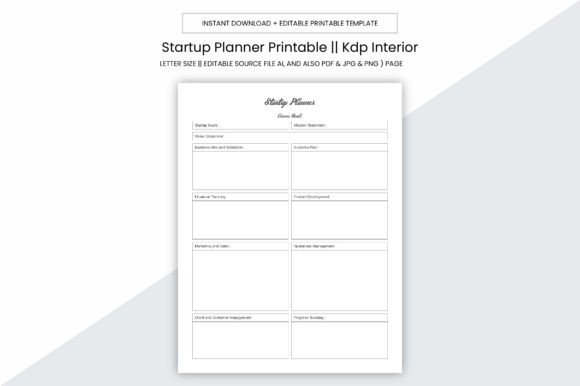
Startup Planner Kdp Interior: A Purpose-Built Digital Toolkit for Print-Ready Business Organization
When launching a venture—whether it’s a solo creative practice, a local service business, or a scalable KDP publishing operation—the challenge isn’t just generating ideas. It’s sustaining clarity, consistency, and structure across dozens of moving parts: market research, branding decisions, financial projections, content calendars, design iterations, manuscript revisions, and platform-specific formatting requirements. The Startup Planner Kdp Interior addresses this complexity not as a generic notebook, but as a thoughtfully engineered digital interior file system—designed from the ground up for real-world execution.
Why “Interior” Matters More Than You Think
In self-publishing—and increasingly in small business operations—the term “interior” refers to the functional core of a printed product: the pages readers interact with, the layout that guides attention, and the structural logic that supports workflow. Unlike decorative templates or loosely themed journals, the Startup Planner Kdp Interior is built around operational fidelity. Its 109-page PDF interior isn’t filler—it’s sequenced to mirror how creators actually progress: from ideation and validation through planning, creation, testing, and launch. Each section includes intentional whitespace, contextual prompts, and modular grids—not just lines or boxes—that accommodate handwritten notes, typed edits, or digital annotation without visual clutter.
Designed for Real Printing, Not Just Previewing
A common pain point for KDP authors and print-on-demand entrepreneurs is the gap between what looks clean on screen and what prints reliably. This planner closes that gap by adhering to industry-standard production constraints. With a practical size of 8.5 x 11 inches, zero bleed, and crisp 300 PPI resolution, every page renders accurately whether printed at home, sent to a local print shop, or uploaded directly to Kindle Direct Publishing. That means no cropped headers, no misaligned margins, and no last-minute formatting surprises when converting from draft to final interior. The absence of bleed isn’t an omission—it’s a deliberate alignment with KDP’s most widely supported trim sizes, reducing rejection risk during upload validation.
Digital Flexibility Without Compromise
The value of the Startup Planner Kdp Interior extends beyond static PDF use. It ships with editable source files in multiple formats—including native Adobe Illustrator (.ai), layered PNG, high-res JPG, PowerPoint (.pptx), and print-optimized PDF—giving users full control over customization. A graphic designer can adjust color palettes and typography in Illustrator; an educator can repurpose weekly planning spreads into classroom handouts using PowerPoint; a researcher might extract data tables as PNGs for inclusion in presentations. Because all assets are vector- or high-DPI raster-based, scaling or cropping preserves legibility. There’s no pixelation when zooming in on financial projection charts, and no font substitution when opening the PPTX on different devices.
Workflow Integration Across Use Cases
What makes this interior uniquely adaptable is how its architecture supports divergent workflows without forcing uniformity:
- For KDP Authors: Pages include dedicated sections for ISBN tracking, keyword research logs, category testing notes, and royalty projection tables—all formatted to match Amazon’s reporting conventions. The 109-page count aligns precisely with KDP’s minimum interior length for paperback eligibility (without requiring filler content).
- For Local Service Businesses: The interior contains client intake checklists, equipment maintenance logs, seasonal pricing worksheets, and service agreement trackers—structured to support compliance, invoicing, and repeat engagement. Because it’s printable on standard office paper, field technicians or consultants can carry physical copies without relying on battery life or connectivity.
- For Educators & Researchers: Modular layouts allow for syllabus mapping, participant consent form placeholders, citation tracking grids, and qualitative data coding sheets. The lack of decorative borders or fixed imagery ensures accessibility for screen readers and compatibility with university LMS platforms when converted to accessible PDF.
- For Hobbyists & Makers: Includes material cost calculators, prototype iteration logs, craft fair booth prep checklists, and inventory reconciliation tables—designed to scale from weekend projects to micro-businesses without relearning new systems.
Quality as a Functional Requirement, Not a Marketing Claim
“High-quality print” isn’t a vague descriptor here—it’s measurable and consequential. At 300 PPI, text remains razor-sharp even when printed on matte-coated stock; grayscale charts retain tonal distinction without dithering; and line weights stay consistent across printers (laser, inkjet, or commercial offset). This level of fidelity matters when recording fine-grained details: tracking daily burn rate to the cent, logging sensor readings in a hardware startup, or comparing A/B test results across marketing channels. Lower-resolution planners often blur thin dividers or compress spacing, leading users to misread entries or abandon the tool mid-project. The Startup Planner Kdp Interior avoids that failure mode by treating resolution as foundational—not cosmetic.
Practical Size, Intentional Constraints
The 8.5 x 11 inch dimension isn’t arbitrary. It reflects decades of ergonomic and cognitive research on working memory and visual scanning. Studies show that horizontal line lengths between 55–75 characters maximize reading retention—a range this interior consistently honors through intelligent column widths and margin sizing. It’s large enough to accommodate detailed sketches or side-by-side comparison tables, yet compact enough to fit in standard three-ring binders or portable document cases. Unlike oversized planners that sacrifice portability for space, or pocket editions that force cramped handwriting, this size sustains usability across environments: desk-bound strategy sessions, coffee-shop ideation, or on-site client meetings where quick reference is essential.
No Bleed, No Guesswork
Bleed—the extension of background color or imagery beyond the trim edge—is useful for full-bleed photo books but counterproductive for functional interiors. In business and planning contexts, bleed introduces two avoidable risks: first, critical text or grid lines may be cut off during trimming if the printer’s tolerance varies; second, users attempting DIY binding (e.g., spiral or comb) often misalign punches when bleed obscures safe margins. By eliminating bleed entirely, the Startup Planner Kdp Interior guarantees that every header, checkbox, and footnote stays within the printable safe zone—regardless of binding method or print provider. This constraint enables true plug-and-play readiness.
Editable Source Files: Where Customization Meets Consistency
Many planners offer “editable PDFs”—but those are often flattened forms with limited field functionality. In contrast, the included .ai, .pptx, and layered .png files preserve full editability: type layers remain live fonts, colors are swatch-based, and grid structures use non-destructive guides. A marketing consultant could replace placeholder brand colors with their agency’s palette in Illustrator and export updated versions for each client. A nonprofit leader might add bilingual labels in PowerPoint before printing bilingual workshop materials. And because the base design uses open-source-friendly fonts and CMYK-safe color values, there’s no licensing friction when adapting for public or institutional use.
From Planning Tool to Institutional Memory
Over time, the Startup Planner Kdp Interior evolves beyond task management into organizational memory. When teams revisit past product launches, grant applications, or curriculum revisions, the structured format allows rapid pattern recognition: Which assumptions held true? Where did timelines slip—and why? How did early customer feedback map onto later feature requests? Because entries are made within consistent frameworks—not freeform notebooks—the interior becomes a longitudinal dataset. Educators spot pedagogical trends across semesters; hardware startups correlate supplier delays with specific component categories; authors identify which cover designs drove higher click-through rates in pre-launch ads.
Ready for Local Print, Global Distribution
While optimized for KDP, the interior functions equally well for regional distribution. A café owner in Lisbon can print 50 copies at a local reprographics shop for staff training binders. A maker collective in Portland can bind bulk orders for vendor kits using saddle-stitching. A university incubator can license the interior for student entrepreneur cohorts—adding institutional branding while preserving all functional scaffolding. The digital delivery model eliminates shipping costs, customs delays, or inventory risk—yet the output remains physically tangible, tactile, and durable. That hybrid nature—digital origin, physical utility—makes it resilient across economic shifts, connectivity gaps, and evolving platform policies.
Not Just a Notebook—A Designed Interface for Action
At its core, the Startup Planner Kdp Interior operates as a human-centered interface. It doesn’t assume users will adapt to its logic; instead, it adapts to how people think, prioritize, and iterate. The progression from discovery to execution mirrors cognitive load theory—early pages minimize abstraction, later ones scaffold complexity. Prompts avoid vague questions (“What are your goals?”) in favor of concrete actions (“List three metrics you’ll track in Month 1”). Even the typography hierarchy serves function: bold headers signal decision points, light-gray subheaders denote optional context, and monospaced fonts distinguish editable fields from static instructions. This isn’t decoration. It’s design operating in service of clarity.
Conclusion: A Foundation, Not a Finish Line
The Startup Planner Kdp Interior succeeds not by promising perfection—but by removing friction from the messy, iterative work of building something real. It accommodates uncertainty without enabling disorganization. It supports both solitary deep work and collaborative refinement. And because it arrives as production-ready files—not locked apps or subscription portals—it belongs entirely to the user: to annotate, redistribute, translate, bind, archive, or extend. In an ecosystem crowded with flashy tools that demand constant updates or platform lock-in, this interior offers something rarer: quiet reliability, grounded in craft, and calibrated for what comes next—not just what’s trending today.